1AI-Leveraged · L3-L6
Vibe Code
+ 9 Damage · + 1 Tech Debt
"It works on my machine and also in prod, apparently."
A roguelike deckbuilder set in the tech world of 2026 - where you work beside AI agents, ship code you didn't write, and discover that "just use Claude" is both a solution and a curse.
One company. The same fiscal year. Four ways to lose your mind.
It's an unnamed mid-stage tech company - three thousand people, twelve years old, profitable but quietly slowing, mid-pivot to an "AI-native" posture nobody can quite define. Every roadmap deck has an AI section. Every team is told to "leverage agents."
All four playable characters work here, at the same time. The Demanding PM you fight as an Engineer? That's the player in the PM campaign. The reorg that wrecks your quarter is a line item in the CEO's board deck. Claude, Cursor, agents, MCP servers - they aren't heroes or villains here. They're just the new furniture in an old office.
As the Engineer, damage is shipping and the run is won by filling the Promotion meter. Climb higher and that stops being true: over half the things on the calendar can't be killed at all, and as the PM or the CEO, none of them can. They resolve - or they don't.
999 HP. You will not zero it. Ship four Deliverables and it stops - sliding quietly into someone else's sprint.
999 HP, zero interest in your damage. Reach Visibility 5 and they lose interest first - off to micromanage another team.
Every tier ends in a review that does have hit points, and three phases. Survive four of them and the last one is the L7 Founder One-on-One. Win and you're promoted. Lose and the tier starts over.
Recorded straight from the game: the Engineer's terminal, mid-quarter. No mockups.
Every card below is real - names, costs, numbers, flavor, straight from the deck you'll draft. The shortcuts genuinely work. The bill they leave behind is genuinely due.
Over 600 cards · over 380 enemies · over 230 events · over 170 relics. All of it authored. None of it procedurally generated.
sample hand · The Engineer - switch characters in "Four lives" below
+ 9 Damage · + 1 Tech Debt
"It works on my machine and also in prod, apparently."
Modify (cost -1) · + 1 Tech Debt
"Twenty minutes crafting the prompt. Output ships in ninety seconds."
+ 8 Damage · + 1 Tech Debt
"Looks plausible. Lands clean. Blast radius unknown."
- 5 Tech Debt · + Draw 1
"Spend a Tuesday on the boring problem. Future-you thanks present-you."
+ 4 AI Literacy · + 3 Credibility
"30 minutes. No agenda. They tell you what's actually going on."
Delegate 19 Dmg · + 1 Tech Debt
"They prompt. You squint. The PR ships. The tech debt is yours."
Delegate 8 Dmg ×2
"Two tickets. Two engineers. Two Slack DMs. By lunch, both are running."
+ 5 AI Literacy · + 2 Org Standing
"Claude takes the notes. You handle the eye contact. The Report notices both."
+ Commit Milestone · + 1 Tech Debt
"Six bullets out of the chat window. The acceptance criteria are 90% there."
+ 3 Roadmap Credibility · + 1 Momentum
"Three coffees, two Notion docs, one all-hands shout-out. Then the slide."
+ 2 Delivery Velocity · + 1 Momentum
"Decline. 'No agenda, sorry.' Two hours back. Sofia notices."
+ Commit Milestone · + 2 Tech Debt · + 1 Context Rot
"Three OKRs, four prompts, eleven Notion docs, one regret. It scopes ambitiously."
+ 5 Vision Capital · + 2 Board Credibility · + Draw 1
"Eight pages. Three options. One recommendation. Markus reads it twice."
+ 3 Vision Capital · + 2 Visibility
"Demo runs live. Agent does the thing. Room claps. Eng messages Margaret afterwards."
+ 2 Runway · + 1 Burnout
"Forty-two open reqs on hold. Recruiting calls land in voicemail. One month back."
+ 1 Momentum · + 1 Owed Favors
"The win goes out under Sofia's name in the all-hands. Yours is the one nobody had to say."
The same forces that carry a run can quietly end one. Read the room.
Each character isn't a reskin - it's a different win condition, a different deck, a different way the job breaks you. Start free with the Engineer.
 Free base game
L3 → L7 Distinguished
Free base game
L3 → L7 Distinguished
"Some cards are craft. Some cards are 'Let Claude Ship It.' The only strategic question is when to lean on which."
The free base game. Climb from L3 to Distinguished by shipping features and dodging perf theater - deciding, every single turn, whether to write the code yourself or hand it to the agent. The shortcuts work. The Tech Debt and Context Rot they leave behind do not go away.
 DLC · free first tier
L3 EM → L7 VP of Engineering
DLC · free first tier
L3 EM → L7 VP of Engineering
"You don't do the work anymore. You build the people who do - including yourself."
You stopped writing code. Now you manage named reports - each with their own skills and AI literacy - and you delegate instead of attack. Credibility is your health bar: every delegation spends a little, every save rebuilds it, and at zero the org stops listening.
 DLC · free first tier
L3 APM → L7 Director of Product
DLC · free first tier
L3 APM → L7 Director of Product
"You can't ship code. You can only align the room - and the room is never aligned."
There is no code to hide behind. Your health bar is Roadmap Credibility - every slip bleeds it, and at zero the run is over. You work the room through six named cross-org partners - Lin in Engineering, Lukas in Sales, Henrik the Director - each of them aligned, neutral, or quietly against you. You win by delivering the roadmap. Promotion is just a side effect.
 DLC · free first year
Year 1 → Year 5: the Cap-Table Exit
DLC · free first year
Year 1 → Year 5: the Cap-Table Exit
"You're already at the top. The only direction left is 'still here.'"
Margaret's climb isn't vertical - each tier is one fiscal year. You don't get promoted; you survive the year, the Board renews your mandate, and the clock resets. Five years in, the cap table resolves into one of four graded endings - and "still here" turns out to be the most honest win there is.
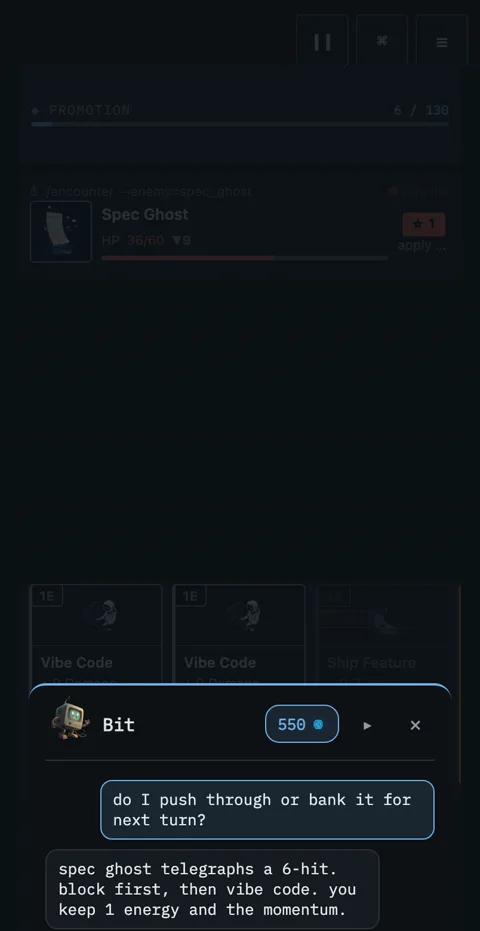
Every character climbs with a companion: Bit for the Engineer, Tally for the EM, Cal for the PM, Quorum for the CEO. Ask it anything mid-fight - it reads the run in front of you - and it debriefs the loss afterwards without scheduling a meeting about it.
"Yes, the game about surviving AI at work ships with its own AI agent. It takes better standup notes than you do."

three compile. six are "directionally correct." review #4 before it reviews you.
eight, straight through their block. and one of your cards just picked up tech debt - that's the deal, every time. banking the momentum before prod notices.
performance summary first, tough questions after. lead with the migration, bury the incident. visibility 4, burnout 6. pace yourself.
Built portrait, one-handed, for the commute - not the desk. Each run nests like the calendar it's drawn from.
One combat, event, rest, or shop - a single meeting on the calendar map.
Five to thirteen encounters across a calendar, with forks: ship-heavy or politics-heavy?
Four quarters as the Engineer, two as everyone else - then the boss. Finish on a coffee break; pick it up on the train home.
A Perf Review, the Quarterly Roadmap Review, or the Cap-Table Exit. Win and you're promoted. Lose and the tier starts over.
Close the app mid-quarter and the company keeps its books. Side goals on a clock, a career record, a filing cabinet of everything you've survived - and four careers running in parallel.
Side goals that reset on a clock, and lifetime milestone chains that never do. Yes, your side goals are called OKRs. No, we're not sorry.
Runs finished, best rank reached, promotions earned, and a win rate per character. The quarters that went badly stay on the record too.
Cards, enemies, relics and the full cast, filling in as you meet them. The org chart you build by surviving it.
Every character keeps its own run in progress, saved between meetings. Put the CEO down mid-crisis, play an Engineer quarter, come back to it.
Tech Debt taxes your shortcuts; Context Rot rots your AI cards. The joke lives in the rules, not the flavor text.
Engineer, Manager, PM, CEO - same fiscal year, same building. An enemy in one game is the player in another.
Vibe Code, Prompt Engineer, and the infamous "Let Claude Ship It" - fast, cheap, and each of those three hands you Tech Debt. Spawn Claude Agent goes further: it summons a junior that misfires half the time.
A few first-run hints point at the meter and the first event, then get out of the way. Don't want them? One switch in Settings and you learn the game the way you learned your job: on the Monday.
Portrait, one-handed, pick-up-and-put-down. Designed for the moments between meetings, not in spite of them.
Nothing to sign up for, and your runs are stored on your device. The game does talk to the network: for updates, for optional analytics you can switch off, for your Cognit balance and purchases, for claiming an OKR reward, for opt-in push notifications, and for the companion. Playing a run needs none of it.
Every run rolls an archetype - Grinder, Politician, Orchestrator, Showman and more - and it decides the cards dealt on top of your core deck and the relic you open holding. Eight per character; the CEO gets five, because there are only five kinds of chief executive.
An original office loop under the work, a second ambient bed under the conversations, and effects made for this game and no other. Haptics on the moments that land, off in one tap.
Reduced motion, half-speed animations, larger text on top of your OS setting, and statuses that always carry an icon and not just a color. Screen-reader labels across the app. Settings, not afterthoughts.






No ads, no timers on your runs, no gacha. The free game is a real game - not a trial dressed up as one.
Free to play.
Each a full, different game.
Only for Bit. Never for power.
No. If you've sat in a standup, sighed at a roadmap, or watched a deadline slide, you already speak the language. The jokes land a little harder if you ship code for a living - but nothing in the game requires it.
No. The Engineer's first two levels are a complete, winnable roguelike - their own bosses, their own draft pools, real runs. The in-app unlock extends the climb to L7; it doesn't paywall the part that's fun. Across the four characters the game ships over 600 cards, over 380 enemies, over 230 events and over 170 relics.
You don't kill the boss - you fill a meter. Enemies resolve the way work actually resolves: scope creep stops once you've shipped enough, the skip-level loses interest. And each of the four characters is a structurally different game, not a reskin - different win condition, different deck, different way the job breaks you.
The game plays offline - your runs and progress live on your device, and there's no account or login. It does reach the network for app updates, optional analytics you can turn off, purchases and your Cognit balance, claiming an OKR reward, opt-in push notifications, and the AI companion. None of that is required to play a run.
No. The full game is playable and winnable if you never open it, and you never have to spend a Cognit. When you do use it, it coaches - reads the board, answers the question, debriefs the loss - and every reply is metered in Cognits, with a daily grant that keeps casual use free. Your chats never feed analytics, and it never plays for you.
It's making fun of the system, not you. Hype cycles, perf theater, metric cults - those are the targets. The people, and the AI furniture they work beside, are treated with affection. The game laughs with you, not at you.
A full run is one fiscal year: four quarters as the Engineer, two as everyone else, then the boss. You can play a single encounter on a coffee break and resume the run later - it's built for portrait, one-handed play. Want something that finishes in one sitting? Try the daily challenge - one scored run a day, same mutator for everyone on your character.
LADDER is live on the App Store and Google Play. Pick your preferred corporate device ecosystem.
Free to play · No ads · No account required